
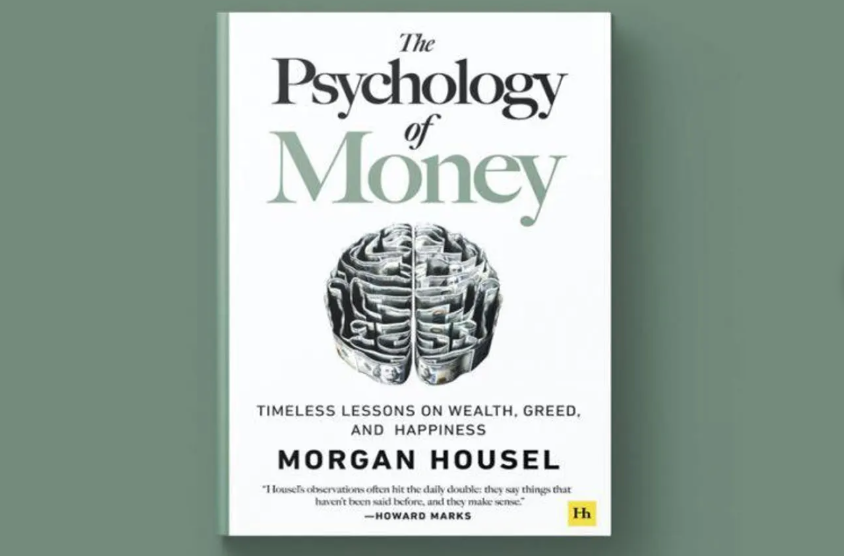
The Psychology of Money
Morgan Housel’s The Psychology of Money distinguishes itself from conventional finance literature by exploring the psychological and behavioural dimensions of financial decision-making. Rather than presenting prescriptive strategies, the book delves into the underlying attitudes, biases, and emotional drivers that shape how individuals interact with money. At its core, it is an examination of human behaviour, demonstrating that financial success is determined less by analytical skill and more by personality and perspective.
A Behavioural Science Perspective.
This book revolves around the principles of behavioural science. Housel states that financial decisions are rarely rational; they are shaped by personal experiences, cultural influences, and random chance. Two individuals with identical financial knowledge may arrive at vastly different conclusions because decisions around money are emotional rather than logical. This behavioural lens is what makes the book particularly interesting for understanding human factors behind financial outcomes.
The Point of Money.
Housel examines the purpose of money, looking at the relationship between wealth and richness. One of the most poignant statements is the concept that the best use of money is to gain control over your time. Housel consistently comes back to the concept that “The ability to do what you want, when you want, with who you want, for as long as you want to pays the dividends”. Wealth, therefore, is best defined not by the accumulation of things but by the capacity to live life on one’s own terms.
The Principle of “Enough”.
A further concept which hit home, is the is the notion of “Enough.” In a society driven by comparison and the pursuit of more wealth, more possessions, or more recognition, Housel emphasises that true financial well-being stems from knowing when one has enough. Defining what constitutes “enough” enables individuals to move away from the cycle of ‘needing’ more, thereby fostering contentment. This principle is about the ability to prioritise long-term stability over immediate gratification.
Beyond those that I believe to be key concepts, Housel also highlights several other aspects and behaviours that impact financial outcomes. He notes that whilst luck and risk are intangible, they have a very real impact. Outcomes are often influenced by factors beyond one’s control. Acknowledging this encourages a focus on elements within our control, such as savings and spending habits. Housel states that savings reflect the gap between ego and income and that when ego outpaces income, wealth becomes unattainable, meaning resisting the urge to impress others is essential for financial independence. Finally, Housel states that time is the most powerful force in investing. Compounding transforms modest actions into significant results over extended periods. Time also mitigates the impact of errors, underscoring patience as the most valuable investment skill.
This book is less about money and more about life. It challenges you to rethink what wealth means and to align financial decisions with values like freedom, stability, and contentment. For me, it reinforced that mastering money starts with mastering behaviour—and knowing when enough is truly enough.