
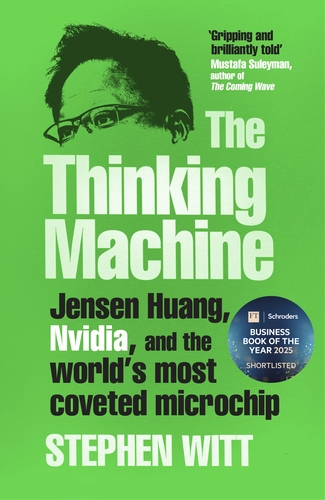
The Thinking Machine: Jensen Huang, Nvidia, and the World’s Most coveted Microchip
Stephen Witt’s `The Thinking Machine: Jensen Huang, Nvidia, and the World’s Most Coveted Microchip’ is a gripping account of how Nvidia rose from a niche graphics card maker to one of the most valuable companies in the world. At its core, the book explores the vision and relentless drive of Jensen Huang, Nvidia’s co‑founder and CEO, whose contrarian bets reshaped the computing industry. A well-researched book, it is based on Witt`s interactions with Huang and his existing as well as former colleagues and acquaintances.
Born in Taiwan and raised partly in Thailand, Huang migrated to the United States at the age of ten with his brother. He studied in a boarding school in Kentucky, where he became a target of bullies, yet never backed off and thrived academically. He subsequently went to Oregon State University, simply because that is where his friend was going. Jenson started his career at Advanced Micro Devices, a Silicon Valley chip company that competed with semiconductor giant Intel. He later joined LSI Logic, an innovative firm that developed the first design tools for chip architects, where he rose quickly and ultimately led a $250 million division. When Chris Malachowsky and Curtis Priem, two chip designers who worked at Sun Microsystems, a client of LSI, established a startup, they asked Huang to join them as a co-founder. And so Nvidia was born in 1993. Huang has been in the semiconductor industry from the very beginning of his career.
Through various instances highlighted in the book, Witt is able to provide readers with a vivid sense of Huang’s character — his vision, his intensity, and his relentless drive. The book captures both his charisma and his uncompromising standards, painting a nuanced portrait of a leader who reshaped the semiconductor industry. The narrative doesn’t shy away from the darker aspects of Huang’s management style. It highlights his demanding expectations. Huang was known for his terrible temper and was described as a ranting screamer by some of his employees. As one employee highlighted `yelling at people is part of his motivational strategy’. Yet he was loathe to fire employees and few ever left the organization. It was a known fact that Nvidia was full of talent, which says so much about Huang.
Witt takes you through Nvidia’s 30-year journey, which was not a straight-line journey. The company had ups and downs, facing near bankruptcy and defending against activist investors. Following the company listing in 1999, between the summer of 2001 and the fall of 2002, Nvidia shares lost 90 percent of their value. Huang’s tolerance for risk pulled his company through again and again.
Huang’s risk-taking ability was evident from the inception of Nvidia. Instead of trying to compete against giants like Intel and Sun in the general computer chip space, Nvidia focused specifically on PC video games; their chips were designed around parallel computing, specifically to handle complex 3D graphics. “The success rate of parallel computing was zero percent when we came along,” Huang says in the book. “Literally zero. Everyone who tried to make it into a business had failed.” Huang, however, stuck to his guns, notwithstanding widespread cynicism and losing money on it. He was constantly looking for new use applications other than gaming, with researchers being the primary additional users. Huang’s smartest risk was listening to a midlevel researcher who, in 2013, pitched him on a technology called “neural nets,” then a fringe area being explored by a handful of academic researchers. Huang saw the potential, bet heavily on neural nets and set Nvidia on a path that would make his chips the premier tool for today’s AI revolution. It took NVIDIA from being a graphics card brand to a supercomputer one.
The Thinking Machine is a compelling read about a company that is inventing the future. It serves as a case study in how visionary leadership and technological foresight can transform an industry. Nvidia’s rise to a US$4 trillion valuation has been a long journey of bold risk-taking, conviction, and relentless hard work. It’s an inspiring testament to what determination and innovation can achieve.