
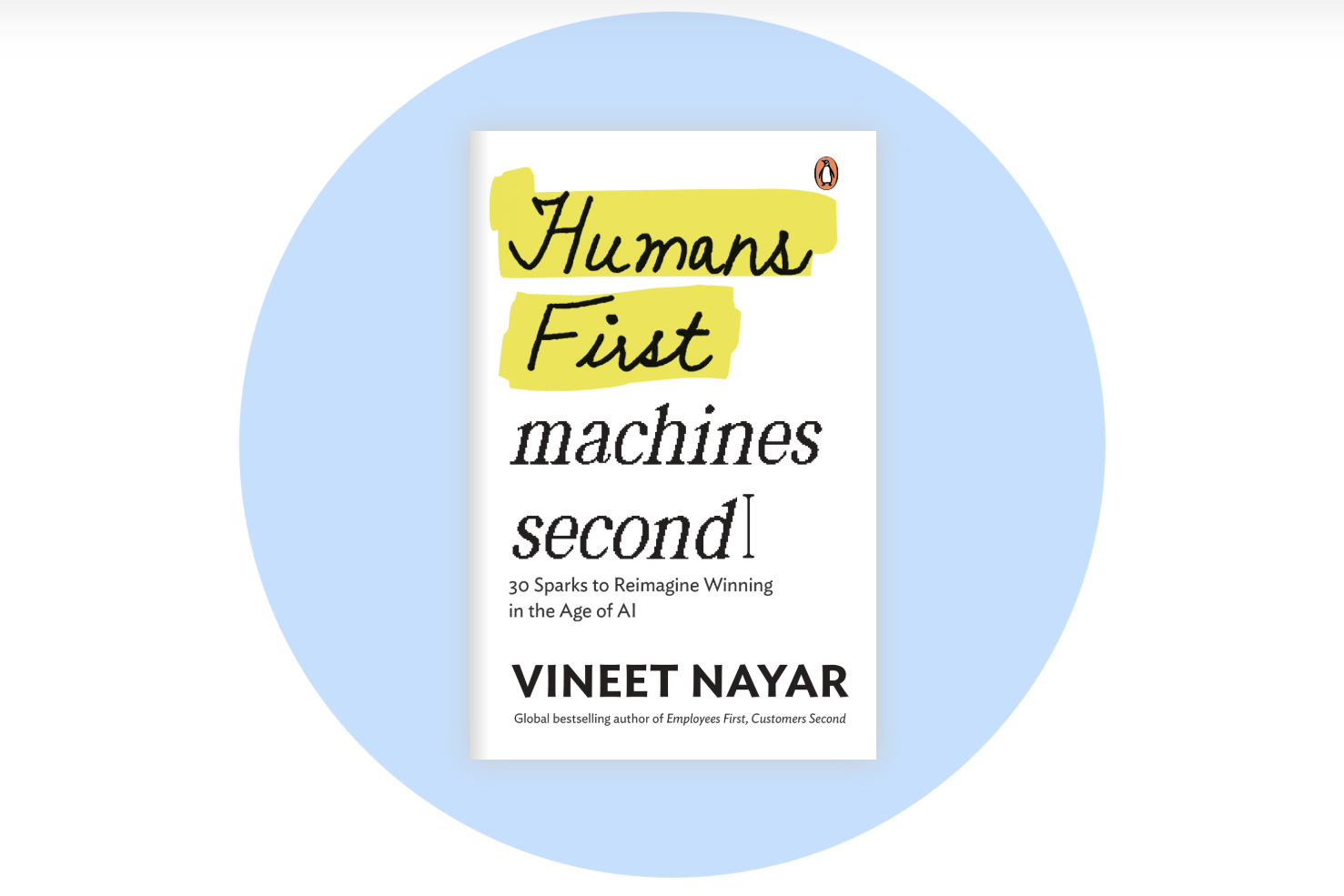
Humans First, Machines Second
Artificial Intelligence (AI) has become the defining buzzword of our time, dominating discussions among students, corporate boardrooms, and the investment community alike. Yet, no matter how much one reads or researches, there remains considerable uncertainty about the form AI will ultimately take and its impact on people, businesses, and society.
What particularly drew me to Humans First, Machines Second was its author, Vineet Nayar. As the former CEO of HCL Technologies, Nayar led one of the most celebrated business transformations in the Indian IT industry. I have long regarded him as a thought leader. Beyond the corporate world, he is also the founder of the Sampark Foundation, one of India’s largest educational philanthropy initiatives. This background is important because Humans First, Machines Second is not written by a technology theorist. It is written by a leader who has managed large-scale organisational transformations and witnessed first-hand how technology influences people, culture, and performance.
The central argument of the book is remarkably simple yet highly relevant: the greatest risk from AI is not that machines become smarter, but that humans begin to lose confidence in their own uniqueness and value. Nayar argues that organisations obsessed with algorithms often overlook the one competitive advantage machines cannot replicate: people. While many organisations are racing to become “AI-first”, he contends that the real winners of the future will be those that remain “human-first”.
AI, in Nayar’s view, should be seen as a tool that amplifies human capability rather than replaces human judgement, imagination, courage, and creativity. The book’s core message is that qualities such as empathy, intuition, and judgement remain uniquely human and will continue to be a sustainable source of competitive advantage.
What sets the book apart is its reliance on real-world experiences rather than abstract theory. Nayar draws on his time at HCL Tech, his entrepreneurial journey with Comnet, and his work at the Sampark Foundation to illustrate his ideas. The book is structured around four themes: Trust, Empower, Reimagine, and Amplify. Across 30 chapters, presented as “Sparks”, he reinforces these themes through a combination of personal anecdotes, leadership lessons, and practical insights into how AI can support decision-making without replacing human judgement.
Importantly, the book is not an argument against AI. Nor does it attempt to explain the technical workings of large language models or speculate on future regulatory frameworks. Instead, it focuses on a more fundamental question: how individuals and organisations can harness AI while preserving the distinctly human qualities that drive innovation, leadership, and progress. Nayar offers a timely reminder that technology should serve people, not the other way around. The book’s enduring message is simple but powerful: the future belongs not to machines alone, but to humans who learn how to use them wisely.
Humans First, Machines Second is a brisk, accessible, and engaging read. Nayar chooses clarity over complexity, making the book relevant not only for business leaders but for anyone seeking to understand the human implications of the AI revolution. More than a management book, it reads like thoughtful advice from a seasoned leader who has navigated periods of profound technological and organisational change. It reminds us that while AI may transform the way we work, our humanity remains our greatest and most irreplaceable asset.