
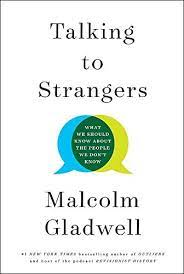
Talking to Strangers
Malcolm Gladwell’s ‘Talking to Strangers’ sheds light on the breakdown
of communication in the context of troubling social and political issues.
It displays his skill of focusing on a particular subject, researching it
thoroughly, and then weaving in other thoughts and themes that often
appear tangential.
The book appears to refer to communication in its title but is in fact more
about miscommunication. How did Fidel Castro fool the CIA for a
generation? Why did Chamberlain think he could trust Hitler? The thread
that holds as you read the book and meander through its myriad stories is that humans tend to
default to the truth – they generally take at face value what people tell them, even when good
judgement would suggest otherwise, and their perception of truth is based on their life experiences.
The book starts and ends with an instance of miscommunication with tragic consequences.
Gladwell analyses the aggressive policing tactics that indirectly led to the death of an African
American woman, Sandra Bland, whose only fault was a minor traffic violation. The routine
violation led to a hostile exchange between her and the police officer, after which Bland ended up
in jail and, three days later committed suicide in her cell. All this over “stopping someone who
should never have been stopped, drawing conclusions that never should have been drawn.” The
premise behind this being that in troubled neighbourhoods there could be weapons or drugs in the
car. Gladwell writes that this is what happens when a society does not know how to talk to
strangers.
The author goes on to take you through a string of stories ranging from the crisis between Cuba
and the United States and its fallout, to the story of Bernie Mandoff, the investor who ran the
largest Ponzi scheme in history, and further on to the case of Jerry Sandusky, the Penn State
University coach convicted of sexual abuse. These three stories, in particular, are based on the
theories of psychologist, Tim Levine, who has done extensive research on why people are deceived
by strangers.
With that said, in some cases a blanket conclusion of ‘failure to communicate’ may be an
oversimplification. Past and present race biases and the Black Lives Matter movement have shown
us that we cannot disregard other factors at play, particularly when looking at the Sandra Bland
case. We would be wrong to attribute what transpired here purely to two strangers who do not
know how to communicate with one another.
There are some examples in the book that come across a little farfetched, for example the use of
an episode of the show ‘Friends’ to make a point about how we rely on people’s facial expressions
when it comes to reading their inner most feelings, emotions and intentions. To use the expressions
and interactions of Rachel, Chandler and the gang as a guide to actual human behavior could be
seen as Gladwell sliding too far to the popular-end of “popular science” writing.
In spite of this, Gladwell’s overriding point throughout this book is very thought provoking; we
do not know how to correctly talk to strangers and, as a result, are inviting conflict and
misunderstanding into our lives in ways that have already had a profound effect in the past, and
will likely have grave effect on the future as well.
How can we change our behaviour, and more importantly, should we? That is the real question.
How can we correctly read people and trust strangers to act right by us? According to Gladwell,
making sense of the stranger “requires humility and thoughtfulness and a willingness to look
beyond [them], and take time and place and context into account”, something that is all too often
ignored.
Aditee Bhalla
July 2021